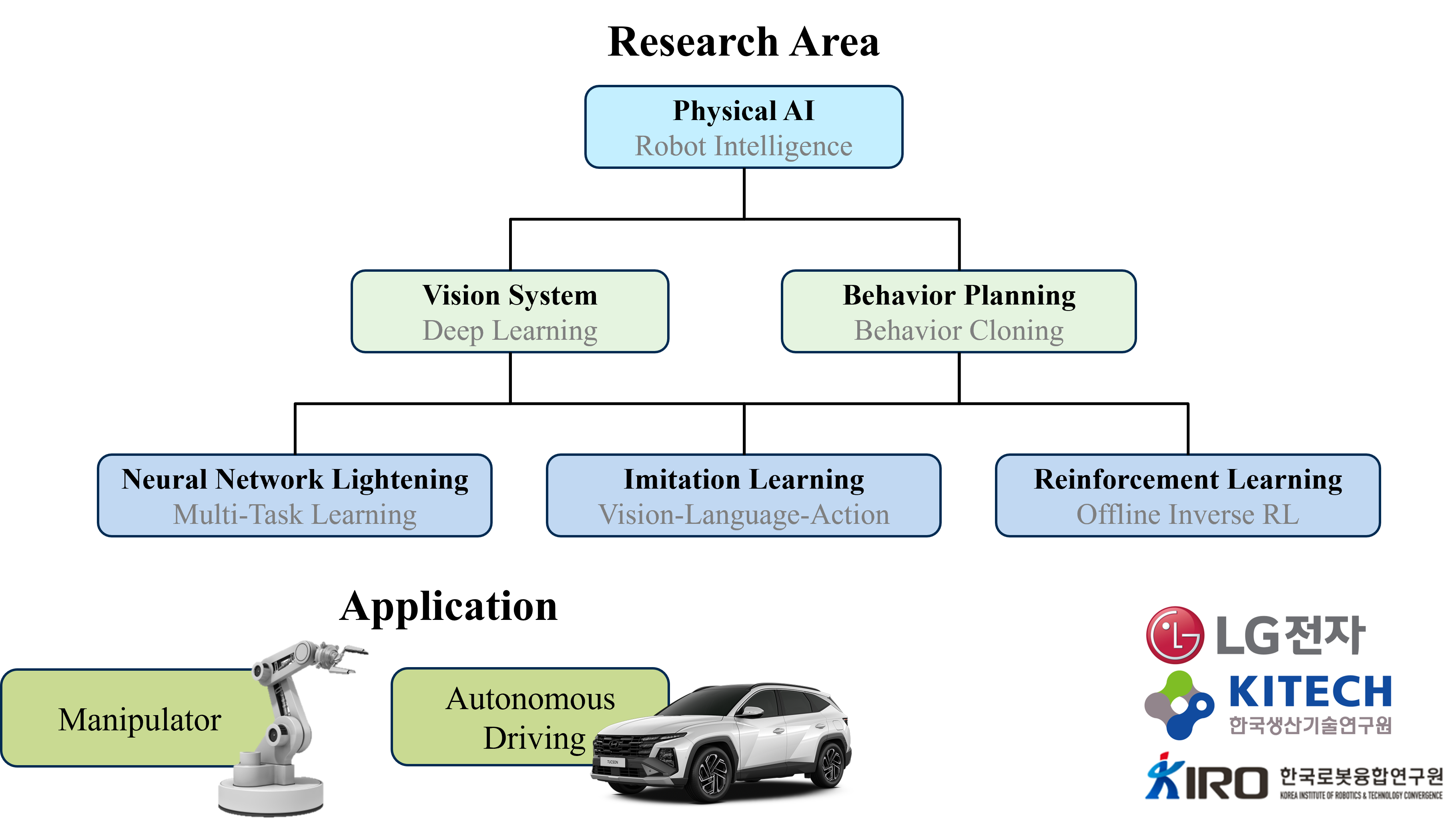
How a robot gets smarter
-
Perceive
Read the world accurately - in rain, at night, on unfamiliar sites.
-
Learn
Improve from interaction and demonstration, not hand-written rules.
-
Decide
Choose the right action in real time, as the scene keeps changing.
-
Act
Move safely on real hardware - vehicles, arms, production lines.
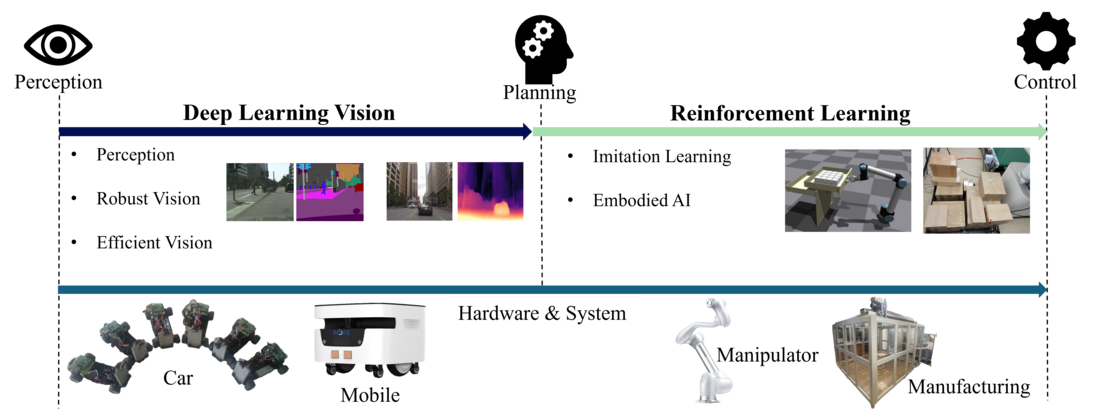
Our approach
Intelligence in robotics does not come from perception or control alone.
We tightly couple deep learning-based vision, reinforcement learning and robot system design into one framework, so that the three improve together instead of separately.
That framework drives our work on autonomous robots, unmanned vehicles, intelligent automation systems and end-to-end learned robotic platforms.
Research areas
- Physical AI & Robotics
- Deep Learning Vision
- Reinforcement Learning
- End-to-End Autonomous Driving